

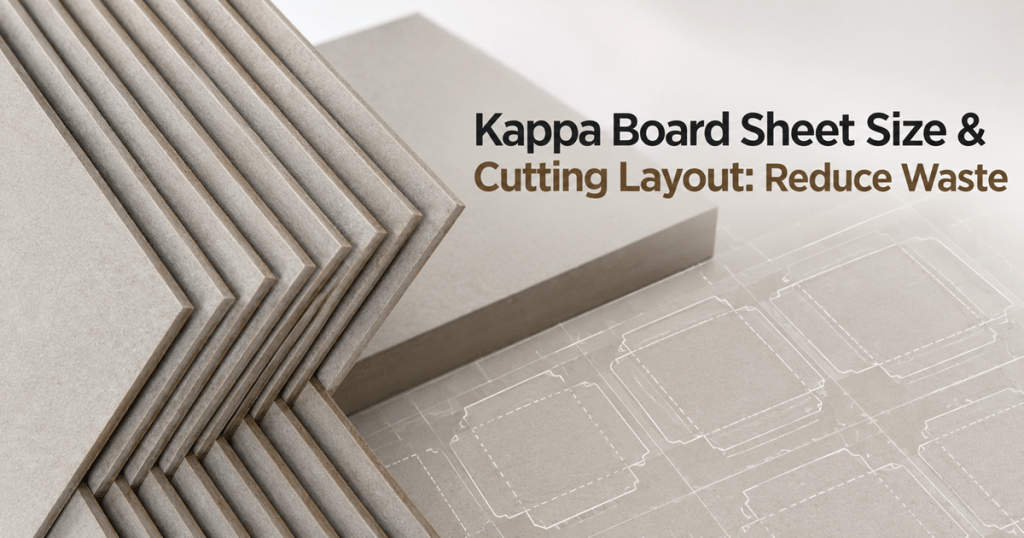
When manufacturing rigid boxes, even a small amount of wasted paperboard can add up across hundreds or thousands of units.
One reason for unnecessary material waste is choosing a Kappa Board sheet size without considering how the individual box panels will be cut.
A board may have the right thickness, GSM and surface finish, but if its dimensions don’t match the production layout, manufacturers can end up with large offcuts or fewer usable panels per sheet.
The most practical way to reduce Kappa Board cutting waste is to plan the panel layout before ordering material, compare different cutting orientations and allow for machine requirements.
For rigid box manufacturers and packaging converters, sheet-size planning can make material purchasing and production more efficient.
Why Does Kappa Board Sheet Size Matter?
Kappa Board is a rigid paperboard commonly used to manufacture premium packaging, rigid boxes, hardcover products and presentation materials.
In rigid box manufacturing, sheets are cut into the panels required for the box base, sides, lid and other structural components.
The amount of usable material depends on how those panels fit within the original sheet.
For example, if a box manufacturer needs several small rectangular panels, a larger sheet may produce more pieces. However, a larger sheet is not automatically more economical.
The important factor is how much of the material can be converted into usable components.
A well-planned cutting layout helps manufacturers:
- Estimate the number of panels available from each sheet.
- Identify avoidable offcuts.
- Compare different sheet dimensions.
- Plan material requirements before production.
- Reduce unnecessary material consumption.
Manufacturers should calculate the usable sheet area after accounting for trimming and machine requirements.
What Is a Kappa Board Cutting Layout?
A cutting layout is the arrangement of individual components on a full paperboard sheet before cutting or die-cutting.
For example, a rigid gift box may require separate pieces for its base, lid and side walls.
The manufacturer must decide how these components will be positioned on the original board sheet.
An effective cutting layout considers the size and shape of each component, the space required between cuts and the capabilities of the cutting equipment.
Sometimes, simply rotating a rectangular panel can increase the number of pieces that fit on a sheet.
However, rotation is only suitable when it does not interfere with material direction, converting requirements or the final product design.
How to Calculate Kappa Board Sheet Utilisation
Sheet utilisation shows how much of the original board area becomes usable cut components.
The basic calculation is:
Sheet Utilisation (%) = (Total Area of Usable Cut Panels ÷ Original Sheet Area) × 100
Consider a simple example.
A packaging manufacturer has a hypothetical board sheet measuring 1000 mm × 700 mm and needs rectangular panels measuring 300 mm × 200 mm.
Layout A: Standard Orientation
With the 300 mm side along the 1000 mm sheet direction:
- 3 panels fit across the width.
- 3 panels fit along the height.
- Total: 9 panels per sheet.
Layout B: Rotated Orientation
With the 200 mm side along the 1000 mm sheet direction:
- 5 panels fit across the width.
- 2 panels fit along the height.
- Total: 10 panels per sheet.
In this simplified example, Layout B produces one additional panel per sheet.
The calculated material utilisation for Layout B is approximately 85.7%, leaving 14.3% of the area outside the ten panels.
Important: These are illustrative dimensions, not confirmed RBR Papers stock sizes. The calculation ignores blade width, edge trimming, spacing and defects. Actual usable yield may be lower, and a more advanced mixed layout may produce a different result.
The example shows why manufacturers should compare cutting arrangements before selecting sheet dimensions.
5 Factors That Affect Kappa Board Cutting Waste
1. Board Sheet Dimensions
Different sheet sizes may produce different numbers of usable components, even when their total areas are similar.
Before placing an order, compare the required panel dimensions with the available board sizes.
If your production requires a particular sheet size, discuss its availability and technical feasibility with the manufacturer.
2. Cutting and Trimming Allowances
A cutting layout needs to account for more than the finished panel dimensions.
Depending on the production process, additional space may be required for:
- Edge trimming
- Blade or cutting clearance
- Die-cutting equipment
- Material handling
- Manufacturing tolerances
Ignoring these allowances can lead to an inaccurate estimate of usable pieces.
Confirm the appropriate values with your production team before calculating the final yield.
3. Board Thickness and Rigidity
Different board specifications may require adjustments to machine settings and cutting methods.
Thicker boards can behave differently during cutting, scoring and grooving.
RBR Papers LLP offers Kappa Board with published thicknesses ranging from 1 mm to 4 mm and GSM specifications from 660 to 2640.
The appropriate specification depends on the finished packaging, converting method and required structural performance.
For detailed material specifications, refer to the RBR Papers GSM Chart.
4. Panel Arrangement
Rigid boxes often require several differently sized components.
Instead of cutting each component type from a separate sheet, manufacturers can evaluate whether different panel sizes can be arranged together.
This may help use areas that would otherwise become offcuts.
However, the layout must still account for cutting sequences, machine limitations and material requirements.
5. Board Flatness and Handling
Even a carefully planned cutting layout may not perform as expected if the sheets are warped or damaged.
Uneven material can affect machine feeding, alignment and cutting accuracy.
RBR Papers describes its Kappa Board as a layer-laminated solid board made from recycled paper, with an emphasis on flatness, rigidity and an even surface.
The company’s Technology & Quality page provides further information about its board characteristics and manufacturing approach.
Proper storage and handling also matter because moisture changes and physical damage can affect paperboard before processing.
How Can Rigid Box Manufacturers Reduce Paperboard Waste?
Reducing cutting waste starts before the board reaches the machine.
Step 1: Confirm the Finished Box Design
Record the dimensions of every required board component.
Include the base, lid, side walls and any additional structural pieces.
Use the actual cutting dimensions rather than relying only on the finished outer box size.
Step 2: Compare Available Sheet Sizes
Review the dimensions of the Kappa Board sheets available for your required grade.
Calculate how many usable components can be produced from each option.
Remember to account for trimming and cutting allowances.
Step 3: Test Different Cutting Layouts
Compare panel orientations and arrangements.
For complex packaging, digital nesting or cutting-layout software may help determine a suitable arrangement.
The best layout should work with the actual manufacturing equipment.
Step 4: Carry Out a Production Trial
Before committing to a large order, test the selected board and cutting layout.
Check panel dimensions, edge quality, cutting performance and whether the pieces assemble correctly.
This is particularly useful when developing a new rigid box design.
Step 5: Review Material Usage
After production, compare the expected number of usable panels with the actual output.
Record damaged sheets, unusable offcuts and other sources of waste.
These results can help improve future cutting layouts and material orders.
Why Should You Discuss Sheet Requirements with Kappa Board Manufacturers?
When sourcing board for repeated packaging production, it helps to share the actual manufacturing requirements rather than requesting material based on GSM alone.
Before contacting Kappa Board manufacturers, prepare the following information:
- Required board grade and thickness
- Target GSM
- Preferred sheet dimensions
- Final packaging application
- Cutting or die-cutting process
- Expected order quantity
- Any specific surface or converting requirements
This information allows a manufacturer to assess which available board specifications may suit the project.
For manufacturers producing premium gift boxes, cosmetic boxes or other rigid packaging, RBR Papers LLP also offers Rigid Box Board intended for structural packaging applications.
Confirm available sheet sizes, minimum quantities, tolerances and delivery arrangements directly before ordering.
Kappa Board Manufacturing at RBR Papers LLP
RBR Papers LLP is an Indian paperboard manufacturer supplying materials for packaging, printing, bookbinding and industrial converting.
Its product range includes Kappa Board, Rigid Box Board, Grey Board, Multilayer Board, File Board and other paperboard products.
RBR’s Kappa Board is manufactured using recycled paper in a layer-laminated solid construction.
According to the company’s published product information, the board offers:
- High rigidity
- Even surface characteristics
- Flatness for converting applications
- Compatibility with cutting, die-cutting, creasing and scoring
- Thickness options from 1 mm to 4 mm
- GSM specifications from 660 to 2640
Manufacturers can discuss their required board specifications and production applications with the RBR Papers team.
For a broader explanation of material grades and selection factors, read the Kappa Board Guide: Types, GSM, Thickness, Uses & Storage.
Looking for Kappa Board Manufacturers in India?
Choosing the correct board specifications and planning an efficient cutting layout can help packaging manufacturers improve material usage and prepare production more accurately.
RBR Papers LLP manufactures Kappa Board and other solid paperboard products for packaging and converting applications.
If you’re planning a new rigid box design or need board for regular production, contact the RBR Papers team to discuss your requirements.
RBR Papers LLP
Phone: +91 9825352062 | +91 9700003398
Email: sale@rbrpaper.com
Website: www.rbrpaper.com
Request a Kappa Board Quotation
Frequently Asked Questions
How can I reduce Kappa Board waste during rigid box manufacturing?
Start by comparing sheet sizes and cutting layouts. Calculate the number of usable components per sheet, include machine allowances and test the selected arrangement before bulk production.
Does a larger Kappa Board sheet always reduce waste?
No. A larger sheet may produce more components, but it can also leave substantial offcuts. The better option depends on the finished panel dimensions and cutting arrangement.
What is sheet utilisation in paperboard cutting?
Sheet utilisation is the percentage of the original board area that becomes usable cut components. It helps manufacturers compare layouts and estimate material efficiency.
Can Kappa Board be die-cut?
Yes. RBR Papers lists die-cutting, creasing, scoring, punching and other converting processes among the applications supported by its Kappa Board. Machine settings should be matched to the specific board.
Can I order Kappa Board in a specific sheet size?
RBR Papers discusses customised paperboard requirements with customers. Availability of a particular size depends on manufacturing feasibility and order conditions, so buyers should confirm specifications before placing an order.
What specifications should I provide to a Kappa Board manufacturer?
Provide your required thickness, GSM, sheet dimensions, application, cutting process and expected quantity. These details help the manufacturer review your material requirements.