

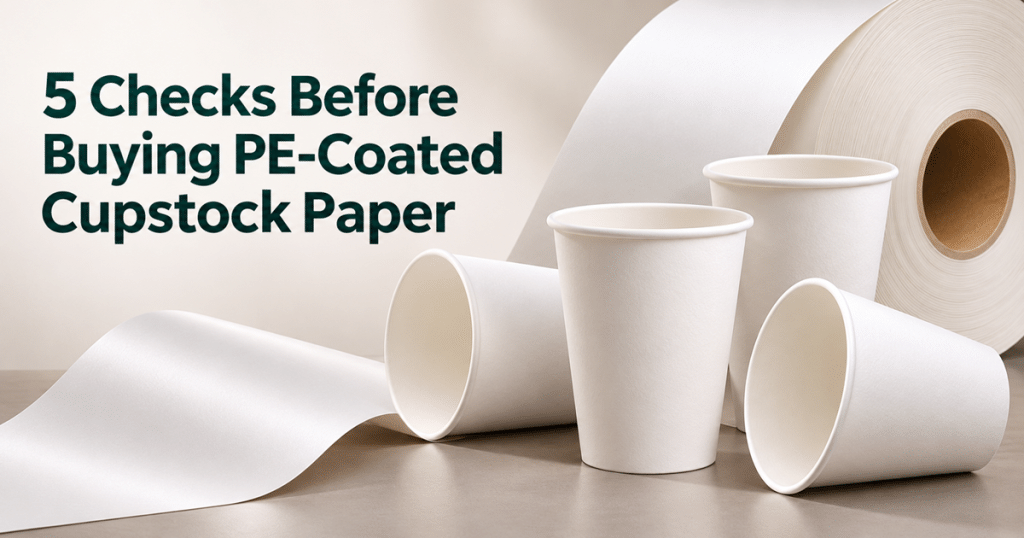
A paper cup might look like a simple packaging product, but producing one involves several important material decisions.
From the paperboard’s stiffness to the coating used for moisture resistance, the raw material can affect how smoothly cups are manufactured and how the finished product performs.
For paper cup manufacturers, choosing the wrong cupstock specification can lead to difficulties with forming, sealing, printing and material waste.
That’s why it’s worth reviewing more than the price per kilogram before placing a bulk order.
Before buying PE-coated cupstock paper, check five important things: base paper GSM, coating type, sealing performance, machine compatibility and food-contact requirements.
Here’s what every paper cup manufacturer should know.
What Is PE-Coated Cupstock Paper?
PE-coated cupstock paper is paper or paperboard with a polyethylene (PE) layer applied to one or both sides.
The paper provides the structure needed to form the cup, while the PE coating helps resist moisture and liquid penetration.
In suitable constructions, the coating also helps create sealed joints during cup manufacturing.
PE-coated cupstock is commonly used for products such as:
- Hot beverage cups
- Cold beverage cups
- Takeaway drink cups
- Paper cups for cafés and restaurants
- Other compatible food-service containers
However, not every PE-coated paper grade is suitable for every food or beverage application.
Material specifications, coating construction, sealing performance and food-contact compliance must be checked for the intended use.
RBR Papers LLP manufactures PE-Coated Cupstock Paper for packaging and converting applications.
1. Check the Base Paper GSM and Stiffness
The first thing to examine is the specification of the base paper.
GSM stands for grams per square metre. It measures the weight of paper over a specific area.
For paper cup manufacturing, GSM is an important material specification, but it shouldn’t be considered in isolation.
Why Does Paper GSM Matter?
The base paper contributes to the strength and structure of the finished cup.
Different cup designs and intended uses may require different levels of stiffness and material weight.
For example, the material requirements for a small beverage cup may differ from those for a larger takeaway cup.
However, choosing a higher GSM doesn’t automatically guarantee better cup performance.
Other characteristics, including thickness, stiffness, fibre structure and coating, also matter.
What Should You Ask Your Supplier?
Before ordering, confirm:
- Base paper GSM
- Paper thickness
- Stiffness requirements
- Intended cup size and design
- Available material specifications
- Relevant manufacturing tolerances
RBR Papers publishes a paper GSM range of 28 to 700 GSM for its PE-Coated Cupstock Paper.
This is the company’s overall published range, not a recommendation that every GSM is suitable for paper cup production.
The correct grade should be selected according to your cup design and machinery.
Buying tip: Share your finished cup dimensions and existing raw material specifications with your supplier before selecting a grade.
2. Understand Single-Side and Double-Side PE Coating
Another important decision is whether your cupstock requires PE coating on one side or both sides.
The coating arrangement affects how the material responds to moisture and how it can be converted.
Single-Side PE-Coated Cupstock Paper
Single-side PE-coated cupstock has a polyethylene layer on one side of the paper.
RBR Papers lists one-side PE-coated paper as an option for hot beverage cups.
In a suitable cup construction, the coated side can provide the internal liquid barrier.
However, the full material specification and cup design must still be checked for the intended beverage and conditions of use.
Double-Side PE-Coated Cupstock Paper
Double-side PE-coated cupstock has a coating on both sides.
RBR Papers identifies two-side PE-coated paper as an option for cold beverage cups.
This construction can be relevant where the exterior of the cup may also be exposed to condensation.
For example, a cold beverage can cause moisture to form on the outside of its container.
An appropriately designed external barrier may help protect the paper substrate from this moisture.
Which Option Should You Choose?
Start with the finished application.
Ask whether the cup will hold hot or cold beverages, what conditions it will encounter and which material configuration the cup-forming process requires.
Don’t assume that double-sided coating is automatically better for every project.
The correct choice depends on the product design, required barrier performance and compatibility with the manufacturing equipment.
3. Verify PE Coating GSM and Heat-Sealing Performance
The PE layer is an important part of coated cupstock paper.
It helps provide a barrier against moisture, and suitable PE coatings can also serve as the sealant in paper cup manufacturing.
But coating performance depends on more than its nominal weight.
What Is PE Coating GSM?
PE coating GSM refers to the amount of polyethylene applied per square metre of coated surface.
RBR Papers lists a coating GSM range of 12 to 40 GSM on its PE-Coated Cupstock Paper product page.
When discussing an order, buyers should confirm the specific coating weight and whether the quoted value applies to one surface or the combined coating.
Why Does Coating Consistency Matter?
Poor coating coverage or defects may affect the material’s ability to resist liquids.
For example, pinholes or damage in the coating can create a pathway for moisture to reach the paper beneath it.
Coating adhesion also matters because the PE layer must remain appropriately bonded to the substrate during the intended converting process.
Check Heat-Sealing Compatibility
During cup manufacturing, the side seam and bottom seal must be formed correctly.
For heat-sealable constructions, sealing results depend on factors such as:
- Coating material
- Sealing temperature
- Applied pressure
- Contact time
- Machine speed
- Material condition
If the material and machine settings are incompatible, the finished cup may develop weak seals or leakage.
Rather than relying only on the coating GSM, ask your supplier about relevant material specifications and perform a trial using your own machine.
Practical tip: Check both the side seam and bottom seal when assessing a sample production run.
4. Confirm Reel Dimensions and Machine Compatibility
Even good-quality paper can create production difficulties if its dimensions or delivery format don’t match your equipment.
Before placing a bulk order, review the requirements of your printing, coating, cutting or cup-forming process.
What Should You Check?
Depending on your production setup, important details may include:
- Required reel or sheet width
- Reel diameter
- Core size
- Winding quality and direction
- Material thickness
- Printing requirements
- Cutting and blank dimensions
- Machine feeding requirements
If you’re purchasing material in reels, check whether the supplied dimensions can be handled by your production line.
Poorly matched dimensions can increase the need for adjustments or additional processing.
Check the Available Width
RBR Papers publishes a width range of 950 mm to 1800 mm for its PE-Coated Cupstock Paper.
Confirm the precise width and available supply format when requesting a quotation.
The company also offers a separate PE-Coated Paper product category.
The appropriate product and specification should be confirmed according to the intended conversion process.
Why Are Trial Runs Useful?
A short trial can reveal issues that aren’t obvious from a specification sheet.
During testing, check whether the material feeds consistently, cuts to the required dimensions and forms correctly.
If printing is involved, assess the print surface and compatibility with the selected printing process.
Remember that results also depend on equipment settings and maintenance.
A successful trial on one machine doesn’t automatically establish suitability for every production line.
5. Check Food-Contact Requirements Before Bulk Ordering
This is particularly important when producing cups intended to hold food or beverages.
A material being described as PE-coated does not automatically establish that it complies with applicable food-contact regulations.
The intended use, material composition, manufacturing process and supporting compliance documents need to be considered.
What Should Indian Paper Cup Manufacturers Know?
In India, food packaging requirements are governed by the Food Safety and Standards Authority of India (FSSAI), including the applicable Food Safety and Standards (Packaging) Regulations and amendments.
Food-contact packaging must meet the relevant requirements for the intended application.
Manufacturers should also check applicable Indian Standards, testing obligations and conformity documentation.
You can refer to the official FSSAI packaging regulations and amendments for regulatory information.
What Should You Request from a Supplier?
Depending on your business and market, you may need to request:
- Material specifications
- Confirmation of intended food-contact suitability
- Applicable test reports
- Relevant conformity certificates
- Coating material information
- Traceability or batch documentation
Requirements can vary by market.
If you manufacture cups for export, check the regulations that apply in the destination country as well.
Test the Finished Cup
Material documentation is important, but finished product testing also matters.
Before approving a new material for bulk production, assess finished cups under representative conditions.
For example, check the relevant liquid resistance, seam integrity and finished cup performance.
Testing should reflect the intended beverage, temperature and use conditions.
Don’t rely on an unverified claim such as “100% leak-proof” or “certified food-safe” without appropriate evidence.
Quick Checklist Before Ordering PE-Coated Cupstock Paper
Use this checklist when comparing suppliers or preparing a technical enquiry.
Common Mistakes Paper Cup Manufacturers Should Avoid
A few purchasing decisions can create problems during manufacturing.
Choosing Cupstock Based Only on Price
A lower material price may look attractive, but production performance also affects the overall cost.
If a material leads to excessive rejected cups or additional machine adjustments, the initial price difference may be less useful than expected.
Assuming Higher GSM Means Better Quality
Higher GSM means more material weight per square metre. It does not automatically guarantee better stiffness, sealing or converting results.
Using the Wrong Coating Configuration
A single-side or double-side construction should be selected according to the intended use and manufacturing process.
Skipping Production Samples
A specification sheet cannot demonstrate every aspect of how a material will perform on your equipment.
Sample trials can help identify issues before a full production order.
Ignoring Compliance Documents
For food-contact applications, confirm that the material and finished packaging meet the requirements that apply to your market.
What Information Should You Send When Requesting a Cupstock Paper Quote?
Providing clear requirements helps the manufacturer understand your application.
Before contacting a supplier, prepare the following information:
If you’re unsure about a specification, explain the intended finished product rather than selecting a material grade without testing.
PE-Coated Cupstock Paper Manufacturer in India: RBR Papers LLP
RBR Papers LLP is an Indian manufacturer and supplier of paperboard and coated paper products.
Its range includes PE-Coated Cupstock Paper, PE-Coated Paper, Kappa Board, Rigid Box Board, Grey Board, Book Binding Board and Multilayer Board.
RBR’s published PE-Coated Cupstock Paper specifications include:
These ranges should be confirmed for the specific product grade and order.
For businesses looking for a PE-coated cupstock paper manufacturer in India, RBR Papers LLP provides a direct enquiry option to discuss material requirements and available specifications.
You can also learn about the company’s published production approach through its Technology & Quality page.
Frequently Asked Questions
What is PE-coated cupstock paper used for?
PE-coated cupstock paper is used to manufacture paper cups and compatible food-service packaging. The polyethylene layer helps provide moisture resistance and, in suitable constructions, supports heat sealing.
What is the difference between single-side and double-side PE-coated paper?
Single-side PE-coated paper has a coating on one surface. Double-side material has coating on both surfaces, which can help address different moisture exposure requirements.
What GSM is suitable for paper cup manufacturing?
The appropriate GSM depends on the cup size, construction, stiffness requirements and machine setup. There is no single GSM suitable for every paper cup.
Does PE-coated cupstock paper prevent leakage?
A suitable PE coating helps resist liquid penetration, but finished cup leakage also depends on coating integrity, seam quality, bottom sealing and production conditions.
Is all PE-coated paper suitable for food-contact applications?
No. Food-contact suitability must be supported by appropriate material specifications, testing and compliance with the relevant regulations.
Does RBR Papers LLP supply PE-coated cupstock paper?
Yes. RBR Papers LLP lists single-side and double-side PE-Coated Cupstock Paper among its product offerings. Buyers can contact the company to confirm grade availability and ordering specifications.
Looking for PE-Coated Cupstock Paper for Your Business?
Choosing the right raw material is an important part of paper cup manufacturing.
Before ordering, review the base paper, coating construction, machine requirements and necessary compliance documents.
RBR Papers LLP supplies PE-Coated Cupstock Paper and other paperboard materials for packaging and industrial applications.
Need PE-Coated Cupstock Paper for Your Production?
Request a Quote from RBR Papers LLP
RBR Papers LLP
Phone: +91 98253 52062
Email: info@rbrpaper.com
Website: www.rbrpaper.com
Technical note: This article provides general purchasing and manufacturing guidance. Product suitability, coating performance, food-contact compliance and converting results must be confirmed for the specific material grade, production process and destination market.