

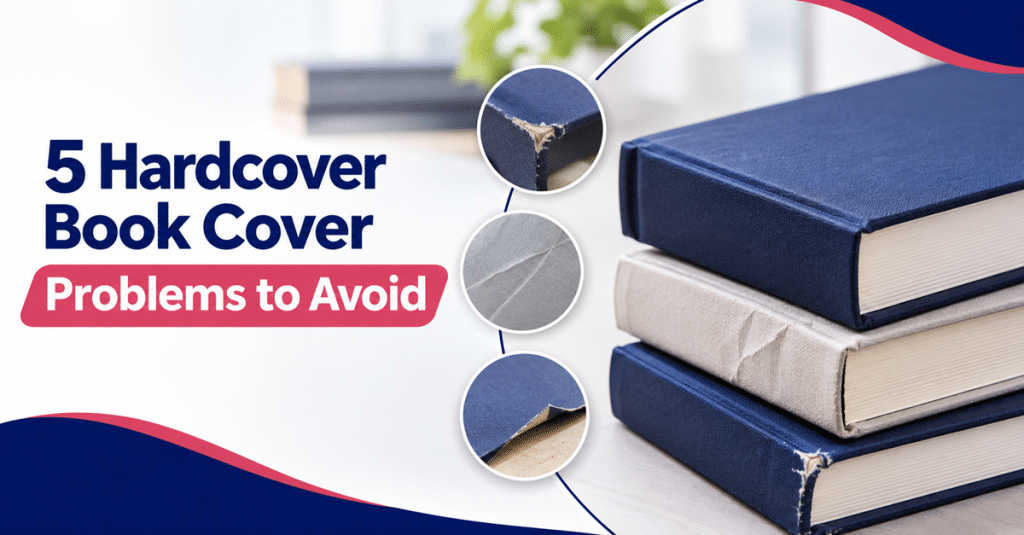
A hardcover book should feel solid, open smoothly and keep its shape during regular handling.
But getting that finished result takes more than selecting a good cover design.
During book and diary manufacturing, problems such as warped covers, uneven edges, loose wrapping and stiff hinges can affect the final product. Sometimes the board is unsuitable for the application. In other cases, the issue comes from cutting, adhesive application, material handling or the binding process.
For manufacturers producing hardcover books, diaries, notebooks and presentation albums, understanding these problems can help reduce avoidable rework.
Five common hardcover book cover problems are warping, incorrect board thickness, uneven cutting, poor wrapping adhesion and problems around the spine or hinge.
Here is what causes these issues and what manufacturers can do to help prevent them.
1. Warped or Bent Hardcover Book Covers
One common problem in hardcover book manufacturing is a cover that bends or curls instead of lying flat.
The cover might look straight immediately after production but begin to warp during drying or storage.
This can affect the appearance of the finished book and how neatly it closes.
Why Do Hardcover Covers Warp?
Warping can occur for several reasons:
- Changes in humidity or moisture content
- Uneven adhesive application
- Different expansion or contraction of covering materials
- Incorrect grain direction
- Inadequate drying or conditioning
- Board that is unsuitable for the cover construction
Paperboard contains fibres that respond to moisture.
When one side of a board changes dimensions differently from the other, the cover can begin to curve.
How to Prevent Cover Warping
Start by checking the condition of the book binding board before production.
Store it in a suitable environment and allow the material to adjust to the conditions in the binding area when necessary.
Check that the grain direction is suitable for the finished book.
In conventional hardcover bookbinding, the board grain generally runs parallel to the spine.
Also review the adhesive application. An excessive or uneven amount of moisture-containing adhesive can contribute to distortion.
Use the adhesive manufacturer’s recommended application and drying procedures.
Finally, produce a sample cover and examine it after the adhesive has fully dried.
A cover that appears flat immediately after assembly may behave differently after conditioning.
RBR Papers LLP supplies Book Binding Board for hardcover books, diaries and related stationery applications.
2. Choosing the Wrong Book Binding Board Thickness
The thickness of a hardcover board influences its rigidity, overall weight and finished appearance.
If the board is too thin for the design, the cover may flex more than intended.
If it is unnecessarily thick, it can add weight and create difficulties during cutting, wrapping or binding.
Does Thicker Board Always Mean Better Quality?
No.
A thick board may be suitable for a large-format presentation album but unnecessary for a small diary.
The correct specification depends on the finished product.
Consider:
- Book height and width
- Weight and thickness of the text block
- Intended use
- Required cover stiffness
- Covering material
- Binding construction
- Cutting and case-making equipment
For example, a large hardcover catalogue and a compact notebook may require different board specifications.
How to Choose the Right Thickness
Start with the dimensions and construction of the finished book.
Then compare suitable material specifications and test them in the intended production process.
RBR Papers LLP lists its Book Binding Board in the following published range:
| Specification | Published range |
|---|---|
| Thickness | 1 mm to 4 mm |
| GSM | 660 to 2640 GSM |
| Application | Hardcover books, diaries, notebooks and stationery |
These are the ranges listed on the company’s product page. They are not a recommendation that every specification suits every book.
GSM describes the weight of material per square metre, while thickness describes its physical depth.
Two boards with similar GSM values may have different thicknesses or stiffness.
For additional material information, refer to the RBR Papers GSM Chart.
Before placing a bulk order, confirm the exact specification, tolerances and suitability for your application.
3. Uneven Cutting and Poorly Aligned Cover Boards
A hardcover book needs accurately cut components.
Even small differences between the front and back cover boards can become noticeable after wrapping and case assembly.
For example, one side may extend farther than the other, or the corners may appear uneven.
What Causes Inaccurate Book Cover Cutting?
Possible reasons include:
- Incorrect cutting dimensions
- Worn cutting blades
- Inconsistent sheet positioning
- Machine alignment problems
- Variations in board thickness
- Damaged or warped sheets
These issues may affect a single cover or an entire production batch.
How to Prevent Cutting Problems
Before starting production, confirm the approved dimensions of the front cover, back cover and spine components.
Make sure the cutting equipment is set up for the selected board specification.
Produce a small batch of components and check their dimensions.
Inspect the edges for rough fibres, damage or irregular cutting.
It is also worth assembling a sample case to confirm that the boards align properly.
Don’t Ignore Board Flatness
Warped sheets may feed inconsistently into certain cutting systems.
That’s why board storage and flatness matter before converting begins.
RBR Papers describes flatness, rigidity and cutting performance among the characteristics addressed in its Technology & Quality information.
However, finished cutting accuracy also depends on equipment, tooling and operator procedures.
Using suitable paperboard is one part of achieving consistent production results.
4. Loose Wrapping, Bubbles or Uneven Cover Finishing
Many hardcover books use decorative paper, printed sheets, cloth or other materials wrapped around a rigid board.
This outer covering creates the finished appearance.
If the wrapping process is inconsistent, the book may develop bubbles, wrinkles, lifting edges or visible corner defects.
Why Does Cover Wrapping Go Wrong?
Possible causes include:
- Uneven adhesive coverage
- Incompatible covering materials or adhesives
- Incorrect adhesive quantity
- Poor surface preparation
- Misalignment during wrapping
- Inadequate pressure or drying
- Incorrect corner folding
For example, if the covering material is not positioned correctly, the final design may appear off-centre.
Likewise, poorly controlled adhesive application can affect bonding and surface flatness.
How to Improve Book Cover Wrapping
Begin by checking that the board surface is suitable for the chosen covering material.
Test the adhesive and covering combination using the actual materials intended for production.
Apply the adhesive according to the manufacturer’s recommendations.
Ensure that the covering material is positioned accurately before pressing or folding the edges.
Inspect the corners and turn-ins after assembly.
If bubbles or wrinkles appear, check the adhesive application, material compatibility and production settings.
Don’t assume that increasing the amount of glue will solve every adhesion problem.
Excess adhesive can introduce additional moisture and create other difficulties.
Why Is a Sample Run Important?
Different covering materials can react differently to the same adhesive or board.
A sample run allows manufacturers to inspect surface appearance, bonding, flatness and corner finishing before starting a larger production batch.
This is particularly useful for premium diaries, branded hardcover notebooks and presentation albums.
5. Stiff Hinges or Damaged Spine Areas
A hardcover book should open and close comfortably.
If the cover feels unusually stiff or the hinge area is poorly formed, the book may be difficult to use.
In some cases, repeated opening can place additional stress on the covering material or the binding construction.
What Can Cause Spine and Hinge Problems?
Possible causes include:
- Incorrect spacing between the cover boards and spine
- Unsuitable board thickness
- Poorly positioned hinge joints
- Incorrect grain direction
- Excessive adhesive or unsuitable adhesive placement
- Inaccurate case-making dimensions
The appropriate construction varies depending on the type of hardcover binding.
How to Prevent Hinge Problems
Check the case-making design before cutting the boards.
Confirm the spacing specified for the spine and hinges.
Make sure the board dimensions match the book block and the chosen binding method.
Pay attention to grain direction.
For conventional case binding, arranging the grain parallel to the spine generally helps the materials behave appropriately when the book opens.
After assembly, test the finished sample by opening and closing it carefully.
Check whether the cover moves as intended and whether the hinge construction remains secure.
If the book feels stiff or does not close properly, investigate the construction before approving the full production run.
A heavier or thicker board is not automatically the solution.
Quick Troubleshooting Checklist for Hardcover Manufacturers
| Common problem | What to check |
|---|---|
| Warped covers | Moisture, grain direction, adhesive and drying |
| Cover too flexible or heavy | Board thickness, stiffness and book dimensions |
| Uneven cover edges | Cutting accuracy, tooling and board flatness |
| Wrinkles or loose wrapping | Adhesive, surface condition and wrapping method |
| Stiff or damaged hinges | Spine spacing, grain direction and case construction |
This checklist provides general troubleshooting guidance. Actual production settings should be based on the materials, equipment and binding method used.
Why Book Binding Board Quality Matters
Book binding board forms the structural base of many hardcover products.
Once the board has been cut, wrapped and assembled, changing it may require substantial rework.
That is why it is worth checking the material before production begins.
Important characteristics include thickness, rigidity, flatness, surface condition and suitability for converting.
For repeat production, consistency between batches also matters.
A board that behaves differently from the approved sample may require changes to the cutting, wrapping or binding process.
Manufacturers should check the supplied material against the agreed specification before beginning large production runs.
If you’re comparing different paperboard products for packaging and stationery, RBR Papers also supplies Kappa Board for a range of rigid paperboard applications.
The appropriate product should be selected according to the finished item and its manufacturing requirements.
What Should You Ask a Book Binding Board Manufacturer Before Ordering?
Before purchasing board for hardcover manufacturing, prepare information about your project.
This will help the supplier understand what you need.
Useful details include:
- Finished book or diary dimensions
- Required board thickness
- Target GSM, if specified
- Sheet dimensions
- Expected production quantity
- Covering and adhesive process
- Cutting and binding requirements
- Any specific flatness or surface requirements
For example, a manufacturer producing premium hardcover diaries may have different requirements from a printing company making large presentation albums.
The more accurately you describe the application, the easier it becomes to discuss suitable available specifications.
For additional purchasing advice, read RBR’s Bulk Paperboard Buying Guide.
Book Binding Board Manufacturer in India: RBR Papers LLP
RBR Papers LLP is an Indian paperboard manufacturer supplying materials for packaging, printing, bookbinding and industrial applications.
Its product range includes Book Binding Board, Kappa Board, Rigid Box Board, Grey Board, Multilayer Board and other paperboard products.
The company’s Book Binding Board is listed for applications including:
- Hardcover books
- Diaries
- Notebooks
- Stationery products
RBR Papers publishes a Book Binding Board thickness range of 1 mm to 4 mm and GSM range of 660 to 2640.
Specific material availability, sheet dimensions and order requirements should be confirmed directly with the company.
If you’re looking for a Book Binding Board manufacturer in India, you can contact RBR Papers LLP to discuss the board specifications required for your production.
Looking for Book Binding Board for Your Manufacturing Business?
Consistent hardcover production starts with selecting suitable materials and following the right converting process.
Whether you’re producing diaries, notebooks, hardcover books or presentation albums, checking board specifications before ordering can help avoid preventable production problems.
RBR Papers LLP manufactures and supplies Book Binding Board and other paperboard products for commercial applications.
Discuss Your Book Binding Board Requirements
Request a Quote from RBR Papers LLP
RBR Papers LLP
Phone: +91 98253 52062
Email: info@rbrpaper.com
Website: www.rbrpaper.com
Technical note: This article provides general information about hardcover book manufacturing. Material performance and production results depend on the board specification, covering materials, adhesives, equipment and binding method. Test the complete construction before approving commercial production.