

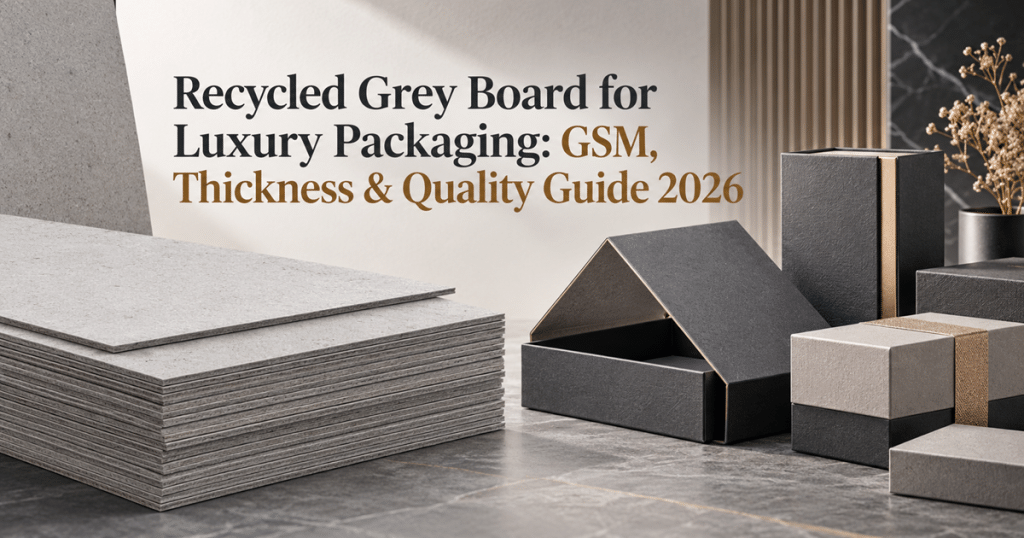
Luxury packaging is more than an attractive outer design. Behind every premium jewellery box, cosmetic gift set or rigid presentation box is a material that helps maintain its shape, support its contents and deliver a consistent finish.
Recycled grey board is widely used as the structural base for rigid packaging. Its solid construction, stiffness and compatibility with decorative wrapping materials make it a practical choice for packaging manufacturers.
However, selecting the right grey board requires careful attention to GSM, thickness, surface quality, rigidity and production requirements. Choosing unsuitable specifications can lead to uneven box edges, warping, manufacturing waste and inconsistent finished products.
For packaging manufacturers, converters and wholesale buyers sourcing materials in 2026, understanding these factors can improve material selection and production planning.
This guide explains how recycled grey board is used in luxury packaging, how to choose suitable specifications and what to consider when sourcing bulk paperboard from a manufacturer in India.
What Is Recycled Grey Board?
Recycled grey board is a thick, solid paperboard manufactured using recovered paper fibres. Multiple layers of fibre material can be combined and compressed to produce boards with different thicknesses, weights and structural characteristics.
Unlike corrugated cardboard, which includes a fluted layer, grey board has a solid structure. It is commonly used for rigid boxes, book covers, presentation packaging and other applications requiring dimensional stability.
In luxury packaging, grey board generally forms the internal structure of the box. The outside is then covered with printed paper, specialty paper, textured materials or decorative finishes.
The strength and appearance of the finished box depend on the board specification, packaging construction and converting process.
Key Benefits of Recycled Grey Board
Structural Support
Helps rigid boxes retain their shape during handling and use.
Different Thickness Options
Allows manufacturers to select board specifications according to packaging requirements.
Surface Compatibility
Suitable grades provide a stable base for decorative paper wrapping.
Recycled Fibre Content
Uses recovered paper as a raw material.
Manufacturing Versatility
Can be processed through cutting, scoring, creasing and other converting operations.
Multiple Applications
Used in gift packaging, cosmetics, jewellery boxes, bookbinding and presentation products.
Recycled grey board performance varies by grade and manufacturer. Buyers should assess the material against their specific packaging requirements rather than relying only on its recycled content.
Why Recycled Grey Board Is Used in Luxury Packaging
Premium packaging often needs a combination of stiffness, dimensional accuracy, attractive finishing and product protection.
Recycled grey board can provide the structural base required for these applications when the correct grade is selected.
1. Structural Rigidity for Premium Boxes
Rigid boxes need to maintain their form during opening, closing, stacking and transportation.
Grey board supports the walls, base and lid of the packaging. Its suitability depends on factors such as board thickness, density, stiffness and the size of the finished box.
2. Suitable Base for Decorative Finishes
Luxury packaging often includes printed wrapping paper, embossing, foil stamping and textured surfaces.
A flat, consistent grey board base helps manufacturers achieve a neat final appearance. Uneven surfaces or warped panels may affect the finished box after wrapping.
3. Recycled Material for Packaging Production
Using recycled grey board allows manufacturers to incorporate recovered paper fibres into selected packaging products.
However, the environmental performance of finished packaging depends on more than its board content. Adhesives, plastic films, coatings and other components can influence recyclability and disposal options.
4. Flexible Packaging Applications
Recycled grey board can be used in different rigid box designs, including lid-and-base boxes, magnetic closure boxes, drawer boxes and presentation packaging.
The board specification should be selected according to the final structure and manufacturing method.
Understanding GSM and Thickness in Recycled Grey Board
GSM and thickness are among the most important specifications when purchasing grey board for luxury packaging.
Although these measurements are related, they describe different properties.
What Is GSM in Grey Board?
GSM stands for grams per square metre. It measures the weight of paperboard per unit area.
For example, a 1,000 GSM board weighs approximately 1,000 grams per square metre.
GSM helps buyers compare board weights and calculate material requirements. However, a higher GSM does not automatically guarantee better stiffness or packaging performance.
Board density, fibre composition and manufacturing methods also influence strength.
What Is Grey Board Thickness?
Thickness, also known as caliper, refers to the physical depth of a paperboard sheet.
It is usually measured in millimetres (mm).
Thickness affects rigid box construction, edge appearance, grooving requirements and finished packaging dimensions.
Two boards with the same GSM can have different thicknesses because their densities differ.
RBR Papers LLP Recycled Board GSM and Thickness Specifications
According to the official RBR Papers LLP Recycled Board product page, the company’s recycled board is manufactured using 100% recycled paper with a layer-laminated solid construction.
The following specifications are listed on the website:
| Specification | RBR Papers LLP Recycled Board |
|---|---|
| Raw Material | 100% recycled paper |
| Board Construction | Layer-laminated solid board |
| Thickness Range | 1 mm to 4 mm |
| GSM Range | 660 GSM to 2640 GSM |
| Key Characteristics | High rigidity, flatness and even surface |
| Processing Compatibility | Cutting, die-cutting, creasing, scoring, embossing and debossing |
These are the published product ranges. Buyers should confirm available GSM and thickness combinations, tolerances and sheet sizes directly with RBR Papers LLP before ordering.
The company also describes its recycled board as suitable for various mechanical converting processes, making it relevant to manufacturers working with custom paperboard products.
How to Choose the Right Grey Board Thickness for Luxury Packaging
Choosing the thickest board available is not always the best solution. Excessive thickness can increase material consumption and may create difficulties during cutting, grooving or folding.
The appropriate specification depends on the size, construction and intended use of the packaging.
Small Jewellery and Accessory Boxes
Smaller rigid boxes often require accurate dimensions and clean edges.
The board should provide sufficient stiffness without adding unnecessary bulk. Packaging manufacturers should evaluate how the board performs with decorative coverings and inserts.
Cosmetic and Perfume Packaging
Cosmetic gift sets and perfume boxes may require stronger structures, particularly when packaging glass bottles or multiple products.
The board must work together with internal inserts to support the contents and limit movement.
Large Gift and Presentation Boxes
Larger boxes have wider panels that may bend or bow if the material is insufficiently stiff.
Manufacturers should evaluate thickness, bending stiffness, panel dimensions and box construction before selecting the material.
Magnetic Closure and Drawer-Style Boxes
These box styles require accurate dimensions and stable panels.
Board thickness consistency can influence closure alignment, drawer movement and finished box quality.
There is no universal GSM or thickness suitable for every luxury box. Prototype testing is recommended before confirming a production specification.
For additional technical information, explore RBR’s Kappa Board guide covering GSM, thickness and material selection.
Five Quality Factors to Check in Recycled Grey Board
High-quality luxury packaging depends on more than board weight.
Manufacturers should evaluate the following material properties before purchasing recycled grey board in bulk.
1. Rigidity and Stiffness
Stiffness describes a board’s ability to resist bending.
A rigid box needs sufficient stiffness to maintain its intended shape during handling and use.
However, thickness alone does not determine stiffness. Density, fibre composition, moisture and board construction can influence performance.
Buyers should request suitable samples and conduct tests based on the final packaging design.
2. Surface Smoothness and Consistency
The surface of grey board can affect the appearance of decorative wrapping materials.
An uneven board surface may create visible imperfections, particularly when manufacturers use thin or smooth covering papers.
Consistent surface quality helps support more uniform wrapping and finishing.
3. Thickness Tolerance
Thickness variations can cause problems during automated box production.
These may include uneven grooves, poor-fitting lids, inconsistent edges and difficulties in assembly.
Bulk buyers should confirm acceptable material tolerances with the manufacturer.
4. Moisture Content and Flatness
Paperboard reacts to changes in humidity.
Excessive moisture variation can contribute to curling, warping and changes in dimensions.
Flat boards are especially important for luxury packaging because panel distortion can affect both structural performance and visual presentation.
RBR Papers LLP states that its recycled board manufacturing process includes monitoring humidity and using its own lining paper to support flatness.
5. Cutting and Converting Performance
Recycled grey board should be compatible with the equipment used in manufacturing.
Depending on the application, processing may include die-cutting, scoring, creasing, drilling, punching, embossing or debossing.
The board should be evaluated under actual production conditions to identify potential issues before large-scale use.
Applications of Recycled Grey Board in Luxury Packaging
Recycled grey board is relevant to several packaging industries that require a rigid internal structure and a customised exterior finish.
Jewellery and Watch Packaging
Jewellery boxes require stable walls, well-fitting lids and carefully designed inserts.
Grey board can be covered with decorative papers, fabric or other suitable materials to create a premium presentation.
Its final specification depends on the weight of the jewellery, box dimensions and internal fittings.
Cosmetics and Skincare Packaging
Rigid boxes are used for selected skincare sets, beauty kits and cosmetic gift collections.
Grey board provides the internal structure, while wrapping materials create the desired printed or decorative finish.
For these applications, manufacturers should consider surface smoothness, dimensional stability and assembly accuracy.
Perfume and Fragrance Packaging
Perfume bottles require packaging that can hold the product securely.
Recycled grey board can be used in the rigid outer box, while suitable inserts help protect the bottle.
Material selection should account for bottle weight, box dimensions and transport conditions.
Corporate Gifting and Presentation Boxes
Premium gifting often involves custom-designed boxes with decorative finishes and multiple compartments.
Grey board can be used in lid-and-base boxes, drawer packaging, book-style boxes and other rigid structures.
The material should be selected according to the packaging dimensions and intended use.
Electronics and Accessories Packaging
Rigid presentation boxes are also used for selected electronics and accessories.
The grey board provides structural support, while inserts and other packaging components help hold the product in place.
RBR Papers LLP identifies luxury packaging, gift boxes, cosmetic boxes and electronics packaging among the applications for its Rigid Box Board.
Common Grey Board Problems in Luxury Box Manufacturing
Even when the packaging design is correct, unsuitable board specifications can create production problems.
Understanding these issues helps manufacturers make better material decisions.
| Common Problem | Possible Causes | Recommended Action |
|---|---|---|
| Warped Box Panels | Moisture variation, storage conditions or board instability | Check board flatness and moisture conditions |
| Uneven Corners | Inconsistent thickness or incorrect grooving | Verify board tolerance and machine settings |
| Wrinkled Decorative Wrapping | Surface irregularities, adhesive issues or wrapping tension | Test surface quality and wrapping processes |
| Weak Box Structure | Insufficient stiffness or unsuitable construction | Review board grade, design and inserts |
| Poor Lid Fitting | Cutting inaccuracies or dimensional changes | Check material and finished box dimensions |
| Visible Surface Marks | Uneven board or unsuitable covering material | Test board and wrapping compatibility |
These problems are not always caused by the paperboard itself. Adhesives, equipment settings, storage and box construction can also affect the final result.
For manufacturers producing large quantities of rigid boxes, testing a representative production batch can help identify material-related issues before a full manufacturing run.
Recycled Grey Board vs Virgin Fibre Paperboard
Packaging buyers often compare recycled grey board with paperboard made primarily from virgin wood fibres.
Both materials have their uses, but their suitability depends on the packaging application.
| Factor | Recycled Grey Board | Virgin Fibre Paperboard |
|---|---|---|
| Raw Material | Recovered paper fibres | Primarily virgin wood fibres |
| Common Applications | Rigid box cores, bookbinding and presentation packaging | Folding cartons, specialty packaging and printed products |
| Surface Appearance | Commonly grey and covered with decorative materials | Available in various surface grades |
| Structural Performance | Depends on density, thickness and construction | Depends on fibre properties and board construction |
| Recycled Content | Contains recovered fibres | Varies according to product specification |
| Selection Priority | Rigidity, stability and converting performance | Application-specific surface, strength and other requirements |
For luxury rigid boxes, recycled grey board can be a suitable internal structural material when the finished packaging uses separate decorative wrapping.
Virgin fibre paperboard may be preferred for applications requiring particular printing surfaces or material properties.
Neither material is automatically better for every product.
Is Recycled Grey Board a Sustainable Packaging Material?
Sustainability is an important consideration when selecting packaging materials in 2026.
Recycled grey board uses recovered paper fibres, helping keep those fibres in use as raw material for new products.
RBR Papers LLP states that its Recycled Board is manufactured using 100% recycled paper. This makes recycled fibre content a specific feature of that product.
However, recycled content and recyclability are different concepts.
A rigid box may contain recycled grey board while also including adhesives, laminated papers, metallic finishes or plastic-based coverings.
These additional materials can affect whether the finished packaging can be recycled through available collection and processing systems.
Environmental Factors to Consider
- Recycled content in the board
- Recyclability of the finished packaging
- Material sourcing and manufacturing conditions
- Packaging design and material efficiency
Using recycled grey board can support material sourcing goals, but environmental claims should be backed by suitable evidence.
What to Check Before Buying Recycled Grey Board in Bulk
Buying recycled grey board in bulk requires a clear understanding of production needs.
Rather than selecting material based only on price or GSM, buyers should provide suppliers with the requirements of their finished packaging.
Bulk Buying Checklist
Confirm the required board type, GSM, thickness and acceptable tolerances.
Provide the required sheet size and information about cutting or converting.
Explain the type of rigid box, its dimensions and the approximate weight of the product being packaged.
Identify whether the board will be wrapped, laminated, embossed or processed using other finishing methods.
Share the expected purchasing volume and repeat-order requirements.
Request samples or discuss trial production where available.
Confirm the destination, shipping arrangements and required delivery dates.
Ask about relevant product specifications, available test information and material documentation.
A clear purchasing brief makes it easier to compare suppliers and select material suitable for the intended application.
Choosing a Recycled Grey Board Manufacturer in India
India is an established manufacturing and sourcing market for paperboard used in packaging, printing and industrial applications.
For packaging manufacturers and wholesale buyers, choosing a supplier involves evaluating material consistency, technical requirements, product availability and delivery arrangements.
When sourcing recycled grey board from India, consider whether the manufacturer provides clear GSM and thickness information and can discuss the board’s suitability for your intended packaging.
Reliable communication is also important for repeat orders, where consistency between deliveries helps manufacturers maintain production standards.
Recycled Board and Rigid Box Board from RBR Papers LLP
RBR Papers LLP is an Indian paperboard manufacturer offering products for packaging, printing, bookbinding and industrial applications.
Its product range includes Recycled Board, Rigid Box Board, Kappa Board, Multilayer Board, Grey Board and Bookbinding Board.
The company’s Recycled Board product page lists a thickness range of 1 mm to 4 mm and a GSM range of 660 to 2640 GSM.
RBR also offers Rigid Box Board for applications such as luxury packaging, gift boxes, cosmetics and electronics packaging.
Packaging manufacturers can contact RBR Papers LLP to discuss available board specifications, material suitability and bulk sourcing requirements.
Final Thoughts
Choosing the right recycled grey board is an important part of manufacturing quality luxury packaging.
GSM and thickness provide useful starting points, but they should be evaluated alongside stiffness, surface quality, flatness and converting performance.
For rigid box manufacturers, the most suitable material is one that meets the requirements of the finished packaging and performs consistently during production.
RBR Papers LLP offers recycled paperboard specifications covering 660–2640 GSM and 1–4 mm thickness. Buyers should confirm the appropriate grade and available specifications before placing orders.
Whether you’re developing jewellery boxes, cosmetic packaging, gift boxes or rigid presentation packaging, selecting suitable recycled grey board can help support consistent production and finished box quality.
Request a Bulk Recycled Grey Board Quote
Looking for recycled grey board for luxury packaging, rigid box production or other paperboard applications?
Contact RBR Papers LLP to discuss your required GSM, thickness, board dimensions and bulk order requirements.
Request a Bulk Quote →Frequently Asked Questions
1. What is recycled grey board used for in luxury packaging?
Recycled grey board is used as a structural material for rigid boxes, jewellery packaging, cosmetics boxes, perfume packaging, gift boxes and presentation products. It is commonly covered with decorative paper or other finishing materials.
2. What GSM is suitable for luxury rigid box packaging?
The correct GSM depends on box size, product weight, board density and packaging construction. RBR Papers LLP lists a recycled board range of 660 to 2640 GSM, but buyers should confirm the most suitable specification for their application.
3. What thickness of recycled grey board is available from RBR Papers LLP?
RBR Papers LLP lists Recycled Board in thicknesses ranging from 1 mm to 4 mm. Individual thickness and GSM combinations should be confirmed with the company.
4. Is recycled grey board suitable for jewellery and perfume boxes?
Yes. Recycled grey board can be used as a structural material for jewellery, perfume and other premium rigid packaging. The board and internal inserts should be selected according to the size, weight and protection needs of the product.
5. What is the difference between GSM and thickness in grey board?
GSM measures paperboard weight in grams per square metre, while thickness measures the board’s physical depth in millimetres. Two boards with the same GSM may have different thicknesses due to differences in density.
6. Is recycled grey board strong enough for luxury packaging?
Appropriately specified recycled grey board can provide the stiffness required for many rigid packaging applications. Its performance depends on board construction, density, thickness, moisture condition and the design of the finished box.
7. Is recycled grey board environmentally friendly?
Recycled grey board uses recovered paper fibres, reducing the need for virgin fibre input. However, the environmental impact and recyclability of the finished packaging also depend on manufacturing, coatings, adhesives and disposal conditions.
8. How can I order recycled grey board in bulk from India?
Prepare your required GSM, thickness, sheet dimensions, quantity and delivery destination. You can then contact a manufacturer such as RBR Papers LLP to confirm material availability, specifications and quotation details.