

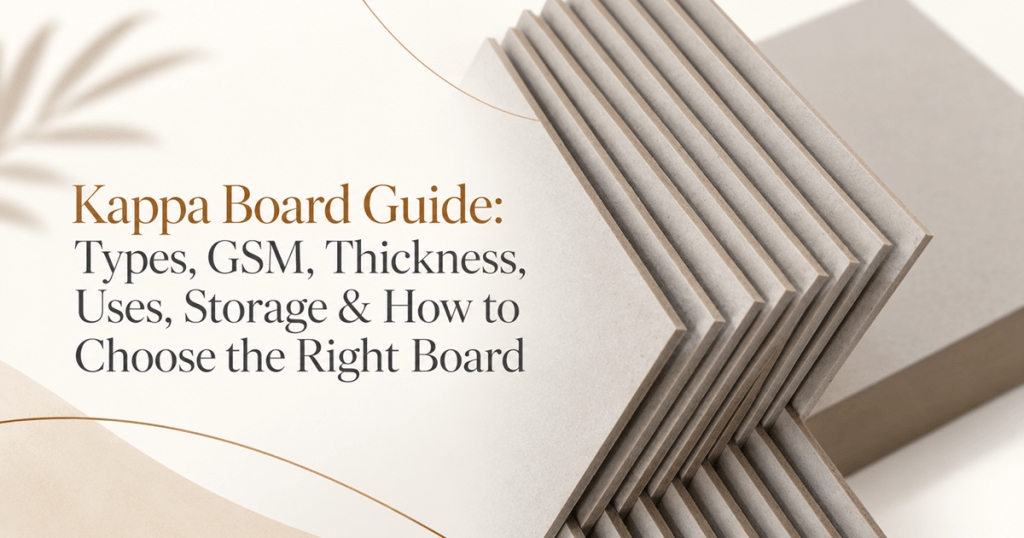
Kappa Board is widely used where packaging, printing or converting work needs a board with good rigidity, flatness and processing performance. It is commonly used for rigid boxes, premium packaging, book covers, files, display products and other applications where ordinary paper or light card is not strong enough.
At RBR Papers LLP , Kappa Board is produced as a layer-laminated solid board made from recycled paper. The company lists its Kappa Board in thicknesses from 1 mm to 4 mm and GSM from 660 GSM to 2640 GSM, depending on the board construction and requirement.
This guide explains the main Kappa Board types, what GSM and thickness mean, common applications, storage practices and the points buyers should check before choosing a board for production.
What Is Kappa Board?
Kappa Board is a dense, rigid paperboard made by combining and bonding multiple paper layers into a solid sheet. The exact structure can vary by manufacturer and application, but the aim is generally to create a board that offers enough stiffness and dimensional stability for converting processes such as cutting, die cutting, creasing, scoring, punching, drilling, laminating and embossing.
RBR Papers describes its Kappa Board as a layer-laminated board made from 100% recycled paper, with an even surface, high rigidity and a focus on maintaining flatness during processing.
Because Kappa Board is available in different weights, thicknesses and surface combinations, buyers should avoid selecting it by appearance alone. The right specification depends on the finished product, board size, converting method, product weight and required finish.
Common Types of Kappa Board
There is no single universal classification system for Kappa Board. In practice, boards are often differentiated by their surface or lining combination, thickness, GSM, colour and intended use.
1. Grey/Grey Board
Grey/Grey board has a grey surface on both sides. It is a practical choice where the board will later be wrapped, laminated or covered and the natural surface will not remain visible in the finished product.
Typical applications include rigid box structures, file products, book covers, displays and other converted products.
2. Grey/White Board
Grey/White board combines a grey base with a lighter or white-facing side. The white surface can be useful when one side of the board needs a cleaner appearance or a better base for selected printing, lamination or presentation requirements.
3. Grey/PE Board
RBR’s GSM chart also lists Grey/PE constructions. A PE-coated surface is used where a coated face is required for the intended application. The required board should still be selected according to the final product, converting method and performance requirements rather than coating alone.
4. Application-Specific Solid Board
Some buyers choose board according to the end use rather than the surface name. For example, a project may require Rigid Box Board , Book Binding Board , File Board or Recycled Board . These products can have overlapping structural characteristics, but the best choice depends on the actual job.
Understanding Kappa Board GSM
GSM means grams per square metre. It describes the mass of one square metre of paper or board. The internationally recognised method for determining paper and board grammage is covered by ISO 536:2019 .
A higher GSM means more material mass per unit area, but it does not automatically tell you the exact thickness, stiffness or suitability of the board.
This point matters because two boards can have similar GSM values but different thickness or density. That is why GSM should be checked together with thickness and the board construction.
RBR Papers currently lists Kappa Board from 660 GSM to 2640 GSM. For detailed combinations, buyers can refer to the RBR GSM Chart .
Understanding Kappa Board Thickness
Thickness, also called caliper, measures the physical distance between the two surfaces of a board. RBR lists Kappa Board from 1 mm to 4 mm.
Thickness is different from GSM. The standard reference ISO 534:2011 covers methods for determining the thickness, density and specific volume of paper and board.
In practical packaging work, thickness influences how substantial the board feels and how it behaves during cutting, forming, wrapping and assembly. GSM tells you the mass per unit area. Both measurements should be considered together.
RBR already has a detailed article explaining this difference. For a deeper comparison, read GSM vs Thickness in Paperboard, Grey Board and Kappa Board .
Kappa Board GSM vs Thickness: What Is the Difference?
| Factor | What It Measures | Why It Matters |
|---|---|---|
| GSM | Weight per square metre | Helps specify material mass and compare board constructions |
| Thickness | Physical board thickness | Affects board bulk, structure, converting and finished feel |
| Stiffness | Resistance to bending | Important for shape retention and structural performance |
| Surface | Face finish or lining | Affects wrapping, presentation, coating and selected printing needs |
| Flatness | Dimensional stability of the sheet | Helps reduce problems during cutting, laminating and converting |
There is no reliable universal formula that converts every GSM into an exact millimetre thickness. Density, fibre structure, lamination and surface construction can change the relationship. For purchasing, specify both GSM and thickness whenever possible.
Common Uses of Kappa Board
Rigid Box Manufacturing
Kappa Board is widely used as the structural base for premium rigid boxes. The board provides the core shape, while printed paper, decorative paper, fabric or another wrapping material can be applied over it.
Applications may include gift boxes, jewellery boxes, cosmetic packaging, electronics boxes, sweet boxes and other premium presentation packs. Buyers working specifically on this type of packaging can also review RBR’s Rigid Box Board .
Bookbinding and Hardcover Products
Rigid paperboard is commonly used inside hardcover books, diaries, notebooks, albums and similar products. The required thickness depends on the finished size, cover construction, binding method and desired feel.
Files and Office Products
Solid board can be used to manufacture box files, folders and storage products that need to maintain their shape during regular handling. RBR also supplies a dedicated File Board for this type of application.
Displays, Calendars and Promotional Products
Depending on design and converting requirements, rigid board can also be used in display structures, table calendars, presentation products and other printed or laminated items where stiffness is needed.
Industrial Converting
Kappa Board can be processed using operations such as die cutting, creasing, scoring, punching, drilling and embossing/debossing. The exact board specification and machine settings should be matched to the job because a board that works well for one converting process may not be ideal for another.
How to Choose the Right Kappa Board
Choosing the highest GSM or thickest board is not automatically the best decision. A better approach is to start with the finished product and work backwards.
Start With the Final Application
First decide what the board will become. A luxury rigid box, hardcover book, file, display or industrial component can require different levels of thickness, stiffness and surface finish.
Consider Product Weight and Box Size
A larger box or heavier product may need more structural support than a small lightweight pack. The board should be evaluated as part of the complete package design, including its dimensions, joints, wrapping material and internal supports.
Check GSM and Thickness Together
Do not approve a board using GSM alone. Compare the stated GSM with the actual thickness and board construction. This helps avoid buying a heavier board that still does not provide the physical structure required for the job.
Check Flatness
Flatness matters for cutting, laminating, printing and automated converting. Warped sheets can create feeding problems, inaccurate alignment and avoidable production waste.
Match the Surface to the Finishing Process
If the board will be wrapped, laminated, printed or coated, check that the face construction is suitable for the planned process. A Grey/Grey board may work well when both faces will be covered, while another surface may be preferable when one side is visible or requires a specific treatment.
Test Before a Large Production Run
For a new box design, machine setup or finishing process, a production trial can help confirm cutting, creasing, wrapping, glue adhesion and dimensional performance before a large order is converted.
How to Store Kappa Board Properly
Paperboard can exchange moisture with the surrounding air. Poor storage can affect flatness, dimensional stability and converting performance, so storage conditions should be treated as part of quality control.
As a general paperboard-handling reference, Holmen Board & Paper recommends maintaining a printing or converting environment around 45% to 60% relative humidity and 20°C to 23°C to help prevent curl and misregistration. It also recommends keeping moisture-proof wrapping in place until the board has reached the temperature of the processing room. See Holmen’s paperboard handling guidance .
For Kappa Board storage, practical precautions include:
- Store sheets indoors in a clean, dry and stable environment.
- Protect the board from rain, water leaks and direct moisture exposure.
- Avoid unnecessary exposure to very humid or very dry air.
- Keep the original protective wrapping in place until the board has acclimatised to the converting room.
- Rewrap unused material where practical to reduce prolonged exposure to changing humidity.
- Keep stacks properly supported so sheets remain flat and edges are protected.
- Avoid direct sunlight and strong local heat sources.
The correct conditions can vary by board construction and production environment, so buyers should also follow the storage and handling instructions supplied for the specific material they purchase.
Common Kappa Board Buying Mistakes
- Choosing by GSM only: GSM does not tell you the complete thickness, stiffness or converting behaviour.
- Assuming thicker is always better: Excess thickness can add material, weight and converting difficulty without improving the finished product.
- Ignoring sheet flatness: Warped board can reduce production efficiency and affect finishing quality.
- Skipping a converting trial: A board should be tested with the actual machine, adhesive, wrapping material and finishing process where the job is sensitive.
- Ignoring storage conditions: Moisture changes can affect the shape and performance of paperboard before it even reaches the machine.
Quick Checklist Before Ordering Kappa Board
Before requesting a quotation or placing an order, provide the supplier with as much of the following information as possible:
- Final application
- Required thickness
- Target GSM or board construction
- Sheet size
- Surface or lining requirement
- Printing or wrapping process
- Cutting, creasing or die-cutting method
- Finished product dimensions and approximate weight
- Order quantity
- Any special converting or performance requirement
This information makes it easier to compare suitable board options rather than selecting material from GSM alone.
Why Kappa Board Specification Matters
Kappa Board may look like a simple sheet material, but its GSM, thickness, surface, flatness and storage condition can all affect what happens later in production. A well-matched board can support cleaner converting, more consistent assembly and a finished product that holds its intended shape.
For buyers, packaging manufacturers and converters, the main rule is simple: choose Kappa Board according to the finished application, not a single specification. GSM and thickness should be checked together, while flatness, surface requirements, processing method and storage conditions should also be considered.
Need the right Kappa Board for your application? Talk to RBR Papers LLP about the suitable thickness, GSM, size and board specification for your packaging or converting requirements.
Contact RBR Papers LLPFrequently Asked Questions
What is Kappa Board used for?
Kappa Board is commonly used for rigid boxes, premium packaging, hardcover products, files, displays, calendars and other applications that require a stiff solid paperboard.
What is the difference between Kappa Board GSM and thickness?
GSM measures the mass of the board per square metre, while thickness measures the physical depth of the sheet. They are related but are not interchangeable, so both should be checked when selecting a board.
What thickness of Kappa Board is available from RBR Papers?
RBR Papers currently lists Kappa Board from 1 mm to 4 mm in thickness.
What GSM range does RBR Kappa Board cover?
RBR’s main Kappa Board product page lists a range from 660 GSM to 2640 GSM. The exact GSM should be matched to the board construction and required thickness.
How should Kappa Board be stored?
Keep it indoors in a clean, dry and stable environment, protected from water and large humidity changes. Where possible, keep protective wrapping in place until the board has acclimatised to the converting area and rewrap unused material.
Is higher GSM always better for rigid boxes?
No. A higher GSM means more mass per square metre, but it does not automatically mean the board is the best choice for a particular box. Thickness, stiffness, flatness, box size, product weight and converting requirements should also be considered.