

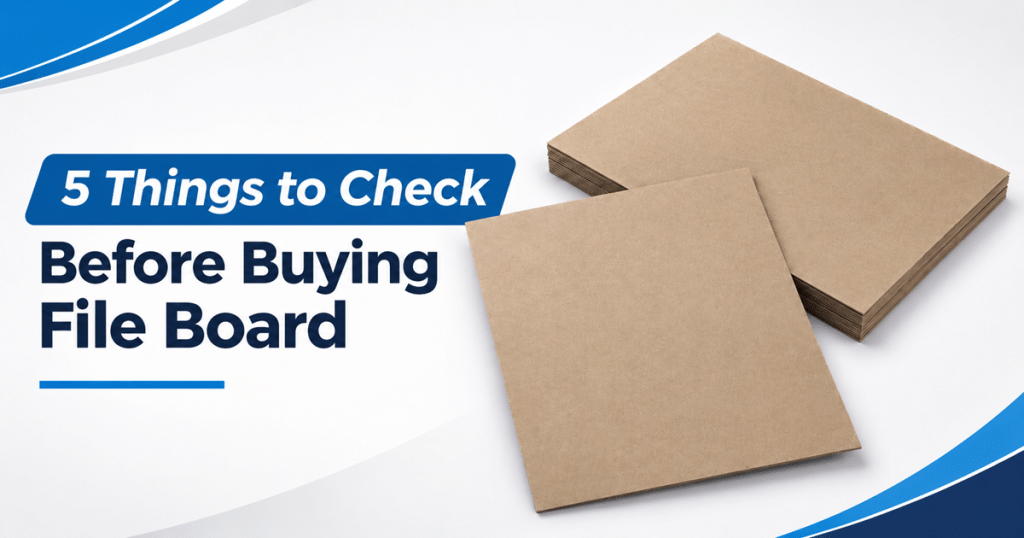
When manufacturing office files, document folders or storage boxes, the quality of the board matters more than it might seem.
A finished file needs to hold its shape, support the contents and withstand regular handling. If the board is too flexible, uneven or difficult to process, manufacturers may face problems with cutting, wrapping, folding and assembly.
For stationery manufacturers producing large quantities of office files, choosing the right raw material can also affect production consistency and material waste.
That’s why comparing file board suppliers based on price alone isn’t always the best approach.
This guide explains what each factor means and how to evaluate file board before placing an order.
What Is File Board?
File board is a type of paperboard used to produce office files, document-storage products and other stationery items that need a firm structure.
It can form the main body of a product, providing support beneath a covering material or decorative finish.
RBR Papers LLP lists File Board for manufacturing box files and storage boxes used to organise and protect documents.
Depending on the product design, manufacturers may also use suitable rigid paperboard when producing covered folders, binders and other filing products.
Common Applications of File Board
File board can be considered for products such as:
- Office box files
- Document-storage boxes
- Hard-cover stationery products
- Covered folders
- File covers with rigid panels
- Other compatible filing and storage products
The appropriate board depends on the finished product’s design and how it will be manufactured.
For example, a lightweight document folder may require different material properties from a box file designed to store a large number of papers.
If you’re sourcing board for commercial stationery manufacturing, understanding these differences is the first step towards choosing a suitable grade.
Explore File Board from RBR Papers LLP for information about the company’s product.
1. Check the File Board Thickness and GSM
One of the first specifications to consider is the thickness and weight of the board.
These characteristics influence the structure of the finished file and how the material behaves during production.
However, thickness and GSM are different measurements.
What Does GSM Mean?
GSM stands for grams per square metre.
It measures the weight of a material over an area of one square metre.
For example, two paperboard samples can have the same GSM but different thicknesses, depending on their construction and density.
This is why GSM alone doesn’t fully describe whether a board is suitable for a particular product.
What Is Board Thickness?
Board thickness, also called caliper, is commonly measured in millimetres.
It is an important dimension when the board must fit into a specific product design or converting process.
For example, the thickness of a board used to manufacture a box file can affect how the panels fit together and how the file interacts with its covering material and hardware.
An unsuitable thickness may require changes to tooling or assembly.
What Should You Ask Your Supplier?
Before purchasing, confirm:
- Required board thickness in millimetres
- Corresponding GSM
- Permitted thickness variation
- Required sheet dimensions
- Whether the grade suits the intended product
- Availability of representative samples
RBR Papers publishes a GSM Chart with thickness, grammage and stiffness information for selected paperboard constructions.
However, the chart should not be treated as a confirmed specification for every File Board grade.
Ask the supplier for the specifications applicable to your particular order.
2. Evaluate Stiffness and Flatness
A file board needs an appropriate level of stiffness to support the finished product.
If the board bends too easily, a file cover or storage box may lose its intended shape.
However, selecting a very stiff board can also create converting difficulties if the design requires folding or forming.
The aim is to choose material that suits the application.
Why Is Stiffness Important?
Imagine manufacturing a box file that will be stored upright on an office shelf.
Its panels need to support the structure of the file during normal handling.
If the board is too flexible for the design, the panels may bend or deform more than intended.
Stiffness can also affect how a product feels when a customer opens, closes or handles it.
What Are MD and CD Stiffness?
Paperboard may have different bending properties in different directions.
These are commonly described as:
Machine Direction (MD): The direction the board travelled during manufacture.
Cross Direction (CD): The direction across the width of the manufacturing process.
Because of the board’s fibre structure and manufacturing process, stiffness can differ between these directions.
For some converted products, the direction of the board within the cutting layout can affect the behaviour of the finished panels.
When stiffness is an important requirement, ask about testing in both directions.
Why Does Flatness Matter?
A board can have suitable stiffness but still cause problems if it arrives bowed or warped.
For example, a curved sheet may be more difficult to feed consistently into a cutting or covering process.
It may also affect the appearance of a finished file.
RBR Papers identifies rigidity, flatness and an even surface among its published paperboard quality characteristics.
How Can You Check Flatness?
During sample evaluation:
- Place the board on a suitable flat surface.
- Look for visible bowing or twisting.
- Check whether the sheet lies evenly.
- Inspect more than one sample.
- Test the board under normal production conditions.
Visible inspection is useful, but technical acceptance limits should be agreed with the supplier where necessary.
3. Test Cutting, Creasing and Punching Performance
File board often needs to be converted before it becomes a finished stationery product.
Depending on the design, manufacturing may involve cutting, die-cutting, punching, scoring, creasing, covering and assembly.
A board that looks suitable as a flat sheet may behave differently when processed.
Why Does Cutting Quality Matter?
Office file manufacturing often requires consistent panel dimensions.
Uneven cuts or damaged edges can affect how panels are assembled and covered.
For example, rough edges may become visible beneath a thin decorative covering.
Incorrect dimensions can also create problems when fitting mechanisms, fasteners or other components.
Check These Areas During Cutting Trials
When testing a sample, look for:
- Clean cut edges
- Consistent panel dimensions
- Excessive dust or loose fibres
- Edge damage
- Delamination between layers
- Smooth feeding through the equipment
The results depend on both board properties and the condition and settings of the machinery.
If a sample cuts poorly, check the tooling and process before concluding that the material alone is responsible.
Why Are Creasing and Folding Important?
Some stationery products require folded areas, shaped panels or defined hinge sections.
However, rigid board should not simply be folded sharply without considering the design and converting method.
A suitable crease, score or other hinge construction may be required.
For example, a file cover with a moving spine needs a construction that allows the cover to open and close without placing unsuitable stress on the board or covering material.
The exact method depends on the type of product being manufactured.
Test Hardware Installation
If your final product includes metal rings, lever mechanisms, clips or other fittings, consider how those components will be attached.
Punching and fastening operations should be assessed using the actual board grade and hardware.
Check whether holes remain accurately positioned and whether the assembly withstands the intended handling.
RBR Papers lists cutting, die-cutting, creasing, scoring, punching and related converting characteristics on its Technology & Quality page.
4. Check Surface Quality and Covering Compatibility
Many office files and folders have a covering material applied over the main paperboard.
This may be decorative printed paper, laminated paper, cloth or another compatible covering.
The underlying board can influence the appearance of the finished product.
Why Does Surface Quality Matter?
Imagine manufacturing a branded office file with a smooth printed outer cover.
If the board underneath has noticeable lumps, dents or uneven areas, those defects may affect the final appearance.
This can be particularly noticeable when using a relatively thin covering material.
Surface quality can therefore be important even when the board itself will not remain visible.
What Should You Inspect?
Check the board for:
- Uneven surfaces
- Visible marks or dents
- Loose surface fibres
- Damaged corners
- Surface contamination
- Areas of irregular thickness
The appropriate acceptance criteria depend on the product and finishing process.
What About Adhesive Compatibility?
If you plan to wrap the board with printed or decorative paper, test the adhesive and board together.
For example, an adhesive may perform differently depending on the covering material, application rate, board surface and drying conditions.
Poor process compatibility may lead to lifting, bubbles or other finishing problems.
It’s important to assess the full covering process instead of assuming the board alone determines the result.
Should You Use Grey Board or White/Grey Board?
The answer depends on whether a particular surface appearance is required.
For a product where the structural board is completely covered, a grey surface may be suitable.
For a design requiring a lighter exposed face, a different surface construction may be more appropriate.
RBR Papers also offers White/Grey Board for applications where a white-facing board is required.
Confirm whether that construction is suitable for your stationery product before ordering.
5. Confirm Bulk Order Quality and Supply Requirements
A sample may work well during testing, but commercial production also depends on consistency across larger quantities.
For manufacturers producing office stationery in bulk, material variations can affect output and increase the need for adjustments.
Why Does Consistency Matter?
Imagine a manufacturer producing thousands of box files using automated or semi-automated equipment.
If the incoming board varies significantly in thickness, flatness or dimensions, the production team may need to adjust its machinery or inspect more finished products.
Material consistency helps reduce avoidable interruptions, although it cannot eliminate every production issue.
What Should You Confirm Before Ordering?
Discuss the following specifications with your supplier:
- Agreed board grade
- Thickness and GSM
- Sheet dimensions
- Acceptable tolerances
- Required quantity
- Packaging and handling arrangements
- Delivery location and schedule
- Quality documentation, where available
- Process for reporting non-conforming material
If your manufacturing process is sensitive to material variation, ask whether agreed inspection criteria can be included in the purchase specification.
Why Is Packaging Important?
Paperboard can be affected by moisture exposure, handling and storage conditions.
Damaged packaging may allow corners or sheet edges to become bent during transport.
Changes in the surrounding environment can also influence the condition of paper-based materials.
For this reason, buyers should discuss suitable packaging and handling requirements with their supplier.
Once the material arrives, inspect the shipment before moving it into production.
Should You Test Every New Supplier?
A production trial is sensible whenever you’re introducing a new board grade or supplier.
For critical applications, periodic checks of incoming material may also be appropriate.
If the supplier changes the specification or construction, confirm whether another trial is needed.
Quick File Board Buying Checklist
Use this comparison table before placing a bulk order.
| Quality Factor | What to Check | Why It Matters |
|---|---|---|
| Thickness and GSM | Millimetres, grammage and tolerances | Helps match the board to the product design |
| Stiffness and flatness | Bending performance, bowing and sheet condition | Supports structural stability and handling |
| Converting performance | Cutting, scoring, punching and assembly trials | Helps identify processing problems |
| Surface compatibility | Smoothness, covering adhesion and final appearance | Affects the finished product |
| Bulk consistency | Dimensions, packaging, agreed specifications and delivery | Supports repeatable production |
This is a practical purchasing checklist rather than a universal technical standard.
Different office file designs may require additional testing.
File Board vs Regular Cardboard: What’s the Difference?
The word “cardboard” is used broadly for many paper-based materials.
However, not every cardboard grade is suitable for manufacturing rigid office files.
A thin, flexible board may work well for a lightweight folder but be unsuitable for a box file that requires firmer panels.
Similarly, a board designed for an unrelated packaging application may not behave as expected during punching, covering or hardware assembly.
The key distinction is the specification and intended application.
When comparing materials, look beyond the product name and assess:
- Thickness
- Stiffness
- Surface quality
- Dimensional consistency
- Converting compatibility
- Performance in the finished product
Choosing a suitable board grade starts with knowing what you need the product to do.
What Information Should You Send When Requesting a File Board Quote?
Providing clear specifications helps the supplier understand your requirements.
Before requesting a quotation, prepare the following details.
| Requirement | Information to Provide |
|---|---|
| Finished product | Box file, document folder, storage box or other application |
| Thickness | Required board thickness in millimetres |
| GSM | Required grammage, if known |
| Sheet dimensions | Required length and width |
| Covering material | Printed paper, laminated paper, cloth or other finish |
| Converting process | Cutting, die-cutting, punching, wrapping or assembly |
| Quantity | Expected order volume |
| Delivery | Required destination and schedule |
If you’re unsure which specification to request, provide a sample or technical drawing of the finished product where possible.
A supplier can then discuss the relevant available grades.
For custom manufacturing, confirm dimensions and performance requirements in writing before the production order is placed.
File Board Manufacturer in India: RBR Papers LLP
RBR Papers LLP is an Indian manufacturer of paperboard products used in packaging, stationery, bookbinding and industrial converting.
Its product range includes:
- File Board
- Kappa Board
- Rigid Box Board
- Multilayer Board
- White/Grey Board
- Book Binding Board
- Recycled Board
- Other paperboard products
The company lists File Board for producing box files and storage boxes.
RBR also publishes information about board rigidity, flatness, surface quality and converting performance.
For stationery manufacturers looking for a file board manufacturer in India, the company provides a direct enquiry option to discuss product specifications and ordering requirements.
Customers should confirm the actual grade, dimensions, availability and performance criteria before making a purchase.
Explore RBR Papers LLP File Board or contact the team with your requirements.
Looking for File Board for Your Stationery Manufacturing Business?
The right file board should match your product design and work reliably with your converting process.
Before ordering, check the thickness, stiffness, surface quality and bulk supply requirements.
Testing samples and agreeing on specifications can help you make a more informed purchasing decision.
RBR Papers LLP supplies paperboard materials for stationery, packaging and other converting applications.
Need File Board for Bulk Manufacturing?
Discuss your required board thickness, GSM, sheet dimensions and order quantity with RBR Papers LLP.
RBR Papers LLP
Vapi, Gujarat, India
Phone: +91 98253 52062
Email: info@rbrpaper.com
Website: www.rbrpaper.com
Technical note: This guide provides general information about paperboard selection. Actual performance depends on board construction, production equipment, processing conditions and the finished product. Confirm the appropriate material specifications and test samples before ordering.